AgriS has continuously enhanced its enterprise RMS in response to macroeconomic conditions and the current implementation of its business strategy. The Company applies various frameworks and standards, such as ISO 31000:2018 and COSO ERM 2017, while incorporating international governance practices (IFC, OECD). Moreover, the system undergoes regular review and consultation from Ernst & Young Vietnam Co., Ltd. As a result, AgriS achieved remarkable growth during a challenging fiscal year, with impressive business results, including record-high revenue and profits that far exceeded annual targets, positioning the Company for significant progress in the next phase.
Agris’s risk management system maintains a 4-layer framework including
.png)
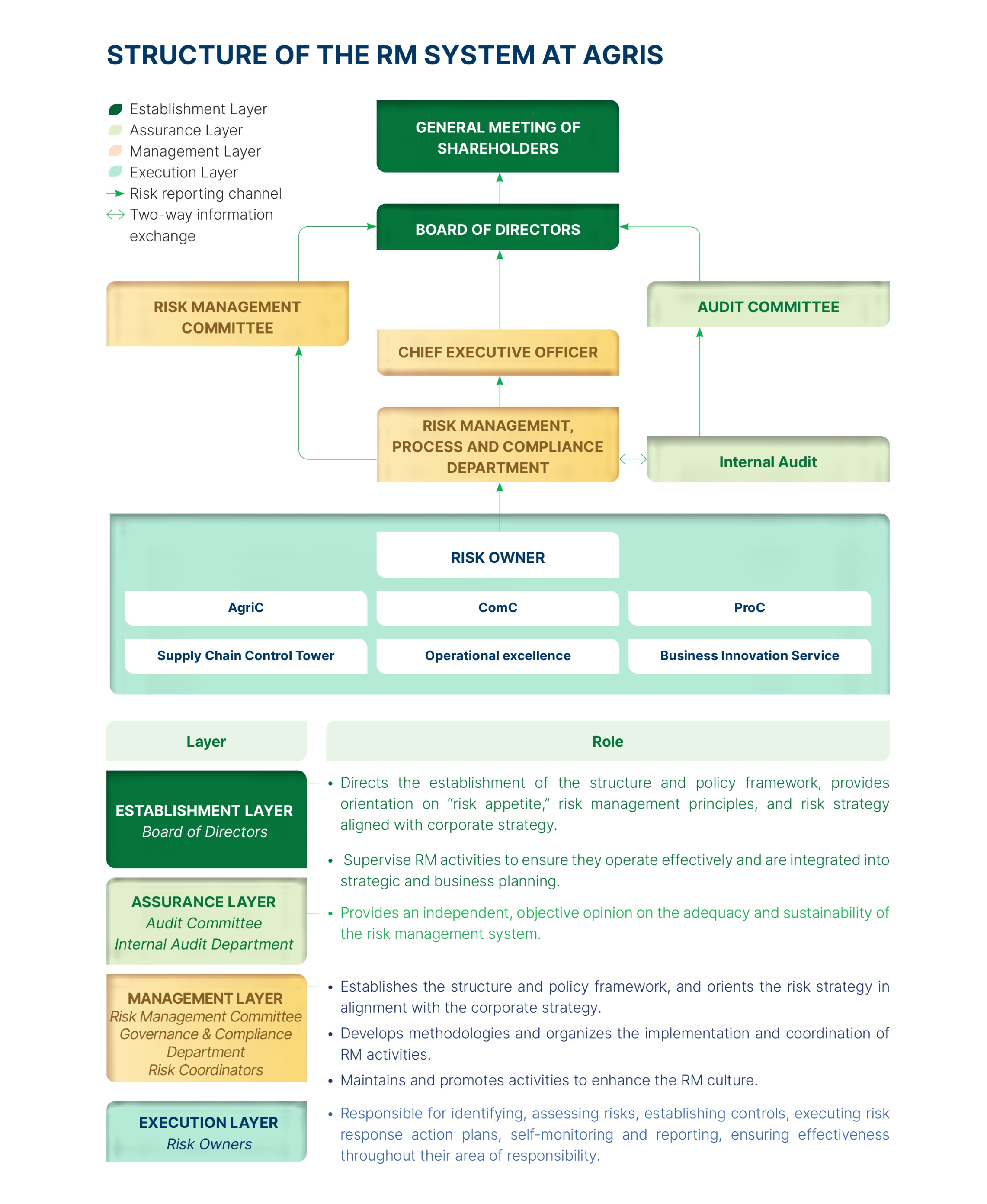
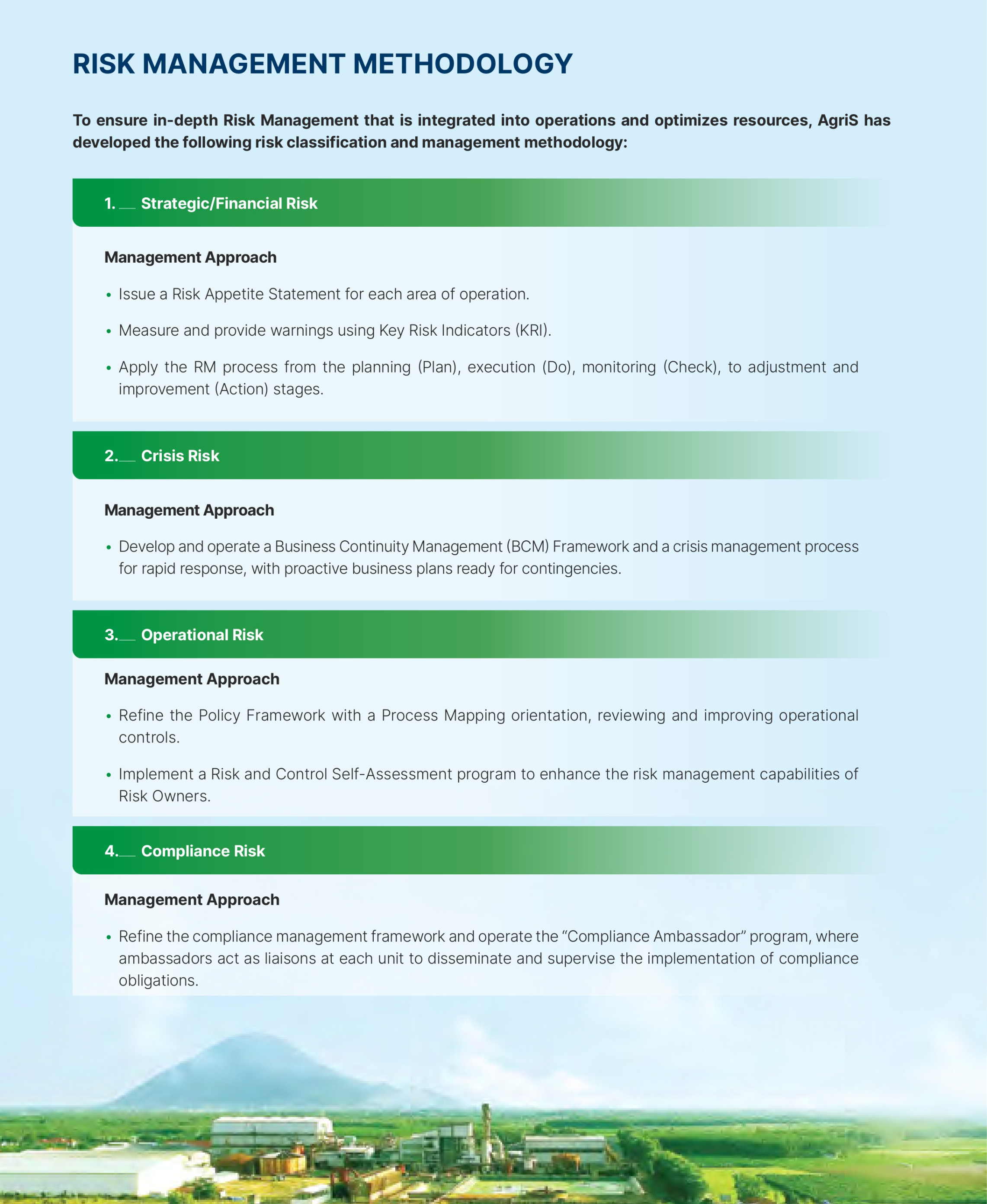
Material risks and controls and results for the 2024-2025 period:
- Risks
- Risk explanation
- Control measures
- 1. Macro risks and business market risks
- 1. Macro risks and business market risks
- The global economy is facing geopolitical risks that disrupt global supply chains and hinder the free movement of goods, including sugar;
- Complex developments in the Bab al-Mandab Strait (Red Sea) are causing blockages in key supply chain routes, which, in turn, lead to increased transportation time and costs;
- The U.S.-China cold war has prompted major countries to adjust their development strategies, reduce external dependencies, and shift supply chains, thereby affecting commodity prices;
- In Asia, disputes in the Taiwan Strait, escalating conflicts, and insurgent groups in Myanmar have disrupted business operations, reduced sugarcane cultivation areas, and affected sugar supply and price.
- The BOD established a Crisis Management Board to coordinate and operate crisis management action plans to address supply, customer, and market risks;
- Proactively monitor market developments (i.e.fluctuations in raw sugar prices, raw materials costs, and transportation costs, etc.), to ensure timely responses and make necessary adjustments to its business strategy;
- Expand sourcing efforts for raw sugar from new markets, develop strategies for buying and selling material inventories, negotiate framework contracts to prevent supply disruptions, and include price adjustment clauses to safeguard against price fluctuations;
- Continue to maintain and introduce a range of support policies for farmers to expand sugarcane cultivation areas and enhance self-sufficiency in raw material inputs;
- Invest in digital transformation projects to improve cost & resource management, minimize production costs, and enhance the Company’s competitiveness in the market.
- See less
- 2. Financial risks
- 2. Financial risks
- High inflation raises uncertainty and the potential risk of financial crisis, particularly:
- Foreign exchange rates peak;
- Credit institutions are approaching their credit growth limits, while deposit/lending rates continuously increase;
- Challenges persist in the corporate bond market.
- Given the aforementioned, the Company could face risks associated with exchange rate fluctuations, rising interest rates, and liquidity;
- Bad debt risk, which, though still under control, remains subject to unpredictable fluctuations.
- The Crisis Management Board coordinates the Divisions implementation of immediate solutions to address financial risks, with the aim of safeguarding liquidity and maintaining the Company’s continuous business operations;
- Diversify sources of capital mobilization (investors, domestic and foreign financial institutions, etc.);
- Implement financial instruments to prepare for foreign currency payment when due and minimize the impact of exchange rate fluctuations;
- Negotiate and adjust payment terms and payment due dates with suppliers;
- Focus on accounts receivable management and collection;
- Optimize inventory control to maintain sales capacity while balancing financial costs;
- Optimize budget planning and management.
- See less
- 3. Information safety and security risk
- 3. Information safety and security risk
- Cyberattack risk: With 70% of cyberattacks targeting information infrastructure, the Company faces a high risk of losing critical information. These attacks can stem from hacker intrusions, incomplete IT systems, or mistakes made by employees in the workplace;
- Data leak risk: This refers to data loss due to internal errors, such as non-compliance with information security procedures or the use of chatbots and AI-powered tools, which make the Company more susceptible to data leaks.
- Provide training on information security policies, and regularly issue warnings and reminders on the proper use and protection of IT equipment and information resources;
- Maintain and regularly monitor the information security management system;
- Establish an authorization matrix to ensure secure access and use of information;
- Prepare disaster recovery plans after an attack or disruption to the IT systems, and conduct annual recovery drills and periodic updates.
- See less
- 4. Risks of implementing trensformation projects
- 4. Risks of implementing trensformation projects
- During the fiscal year, the Company underwent a significant transformation by shifting its operations to a 3-center model: AgrC, ProC, and ComC, along with three services: SCCT, OPE.E, BIS, and the risk management and compliance system;
- To support this new operational model, several digital transformation projects were implemented over the past fiscal year, including Digi Farm, Digi Factory, DMS, WMS, and LMS.
- Potential risks were identified during the implementation process, including project delays, budget overruns, unsuccessful transformations, and, notably, risks in change management throughout the execution.
- Operate a comprehensive and rigorous project management process including project planning, budget management, project quality management, and acceptance, project timeline management, consultant selection, etc.;
- Organize various training, experience sharing, and mutual learning sessions to improve project implementation and management practices;
- Implement a change management process to assess project implementation and impacts on the Company’s stakeholders and operations, in order to propose solutions to minimize these impacts.
- See less
- 5. Enviromental and climate-related risk
- 5. Enviromental and climate-related risk
The complex effects of El Nino and La Nina impact new cultivation efforts by causing insufficient soil moisture and increasing the risk of waterlogging and lodging, which hinder crop growth. Climate change developments may result in yield losses, damage to assets and human resources, and a rise in disease outbreaks.
- Statistically analyze and manage material areas through data maps; evaluate soil fertility to implement suitable farming solutions to ensure productivity for the Company’s material areas;
- Build a weather database for the regions to devise technical adaptation scenarios (drought-resistant varieties, floodresistant varieties) and policies (infrastructure investment, purchase policies tailored to each market situation);
- Enhance the efficiency of agricultural planning and closely monitor each phase throughout the cultivation process to ensure timely responses to any weather changes;
- Regularly update climate trends, seek accurate data sources, enhance property and agricultural insurance coverage, and apply advanced technologies. Furthermore, studying regulations and consumer trends will be an integral part of the Company’s response action plan.
- See less
- 6. Brand repultation risks
- 6. Brand repultation risks
Risks of media and brand crises, when the Company becomes the target of media attacks, may lead to adverse impacts on the Company’s reputation and brand in the market and in the eyes of customers.
- Classify media crises and develop corresponding media crisis management procedures to respond promptly when incidents arise;
- Focus on building the capacity to handle media crises with a dedicated team in place;
- Standardize processes/operations for receiving feedback from customers and partners, with a focus on providing quality products and optimal services to customers in all activities of TTC AgriS.
- See less
- 7. Human resource management risks
- 7. Human resource management risks
- Risks of shortage of high-quality human resources may arise as the Company is evolving fast and the demand for personnel is increasing;
- Employees taking on multiple roles can result in work overload;
- The intensity of competition in attracting and retaining talents is rising.
- Undertake a comprehensive restructuring to effectively realign the workforce;
- Review and introduce competitive compensation, salary, and bonus policies;
- Maintain and develop a fair and transparent competency assessment system, as well as build clear career development roadmaps for employees;
- Organize training programs on soft skills and professional skills to enhance the competency of the employees;
- Expand recruitment sources while implementing succession training programs;
- Create a culture that makes the Company an ideal working environment and fosters employee engagement.
- See less
- 8. Occupational health, safety, and environmental risks
- 8. Occupational health, safety, and environmental risks
During the work process and production operations, it is common for hazardous and harmful elements to be present, posing risks of workplace accidents or occupational diseases, significant losses in terms of both human and financial resources, and long-lasting and severe consequences for employees and the Company.
- Establish and maintain an occupational health and safety management system. Strictly conduct risk assessments, and safety, health, and environmental inspections at all the Company’s factories/offices.
- Organize training and inspections on occupational health and safety issues to promote health and safety awareness of the employees and the reputation of the Company;
- Conduct regular reviews and inspections to ensure compliance with state regulations and internal policies, ensuring that employees follow guidelines and uphold safety and security standards during their work.
- See less